2026 Broadband Competition Report: Most U.S. Homes Now Have a Choice of High-Speed Internet
 By Josh Gerson · Updated

Table of contents
Wifi Shark’s 2026 Broadband Competition Report finds that for most American homes, the days of one internet company in town are over.
- Two in three homes (68.6%) can now choose between two or more high-speed providers using fiber, cable or 5G home internet. In June 2022, it was 40.9%.
- Homes where cable is the only fast option fell from 43.1% to 18.3%, fewer than one in five.
- Counting Starlink, virtually every home in the country now has a high-speed option, and about 95% have at least two.
We analyzed all nine releases of the FCC’s Broadband Data Collection, from June 2022 through June 2026. The FCC data records the service every provider reports at every home in the country. We counted all 114 million homes in the 50 states and DC, not a sample, and applied the same definitions to every release.
What counts as a high-speed provider
Almost every home has some way to get online. What matters for price and quality is how many companies can deliver a fast, modern connection. We count a provider at a home if it reports at least 100 Mbps download and 20 Mbps upload there, the FCC’s benchmark for high-speed broadband.
The main count covers the networks built to serve a neighborhood: fiber, cable, and 5G home internet from T-Mobile, Verizon and AT&T. It leaves out DSL, which rarely reaches those speeds, and smaller fixed wireless networks. Starlink gets its own section below, because it changes the picture in a different way.
Key findings
| June 30, 2026 (50 states + DC) | Share of homes |
|---|---|
| 2 or more fiber, cable or 5G providers | 68.6% |
| 3 or more fiber, cable or 5G providers | 32.6% |
| Fiber available | 62.3% |
| Cable is the only fast option (no fiber or 5G) | 18.3% |
| No fiber, cable or 5G home internet | 5.0% |
| At least one high-speed option, counting Starlink | 99.7% or more |
| 2 or more high-speed options, counting Starlink | About 95% |
How the market changed, 2022 to 2026
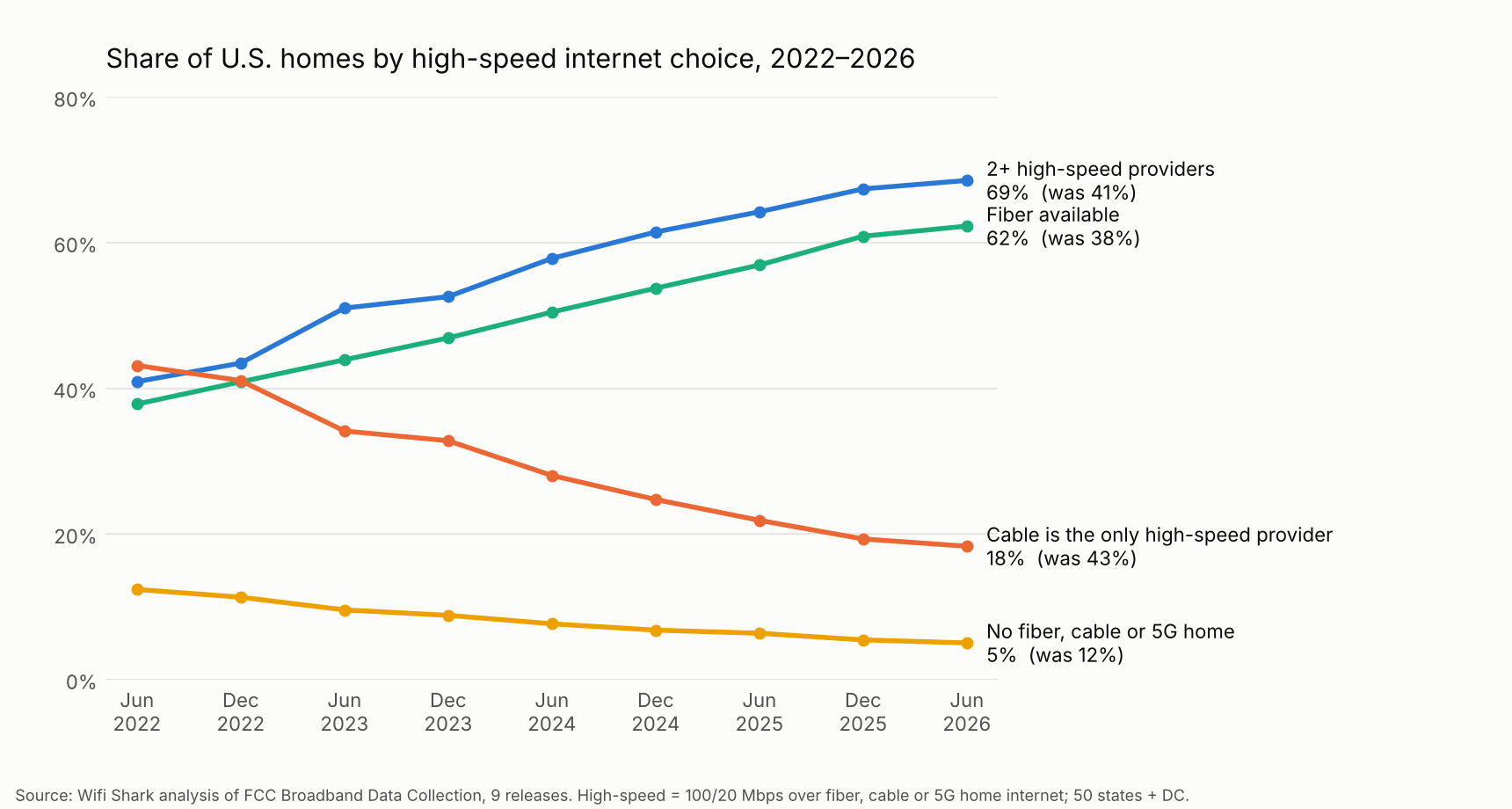
| June 2022 | June 2024 | June 2026 | |
|---|---|---|---|
| 2 or more high-speed providers | 40.9% | 57.9% | 68.6% |
| 3 or more high-speed providers | 9.0% | 22.3% | 32.6% |
| Fiber available | 37.8% | 50.5% | 62.3% |
| Cable is the only high-speed provider | 43.1% | 28.0% | 18.3% |
| No fiber, cable or 5G home internet | 12.4% | 7.7% | 5.0% |
Two things drove the change.
The first is fiber. Fiber now reaches 62.3% of homes, up from 37.8% in 2022, as AT&T, Verizon, T-Mobile and others have kept building. Counting wired networks alone, the share of homes with two or more high-speed providers rose from 34.9% to 54.0%.
The second is 5G home internet. T-Mobile, Verizon and AT&T now sell home internet over their wireless networks, which adds a second option at many homes that used to have only cable. 5G home internet is the second provider for 14.6% of homes, up from 6.0% in 2022.
The biggest gains came where choice had been thinnest. Maine went from 14.9% of homes with two or more high-speed providers to 60.1%, and Wyoming from 14.7% to 57.4%. Hawaii, Utah, West Virginia and Arkansas each gained more than 38 points. In 2022, 43 states had a second high-speed provider at fewer than half of homes. By 2026, only three did: Alaska, Montana and New Mexico.
Starlink: a high-speed option almost everywhere
Starlink reports 100/20 Mbps service at 99.7% of U.S. homes. That’s a big development. Counting it, virtually every home in the country can now get high-speed internet, and about 95% can choose between at least two high-speed options.
It matters most at the 5.0% of homes with no fiber, cable or 5G home internet, mostly in rural areas. For those households, Starlink is the only high-speed provider, and it’s a real step up from DSL or older satellite service.
Starlink is also more affordable than it used to be. It now sells a 100 Mbps plan alongside its faster ones, starting at $27.50 a month as of Nov 27, 2026. Our Starlink guide covers the plans and prices.
We report Starlink separately from the main count because it works differently. A satellite’s capacity is shared across a wide area rather than built street by street, so speeds depend on how many people nearby are using it. Counting it with fiber, cable and 5G would show near-universal choice and hide the change this report measures: how many homes can choose between networks built to serve their neighborhood.
State by state
Competition is strongest in the dense Northeast and Mid-Atlantic, along with Hawaii and Florida, and weakest in large rural states.
Most homes with two or more high-speed providers:
| State | 2+ providers | 3+ providers | Fiber available |
|---|---|---|---|
| District of Columbia | 98.4% | 83.4% | 87.5% |
| Rhode Island | 87.4% | 22.3% | 87.8% |
| Connecticut | 86.3% | 48.9% | 82.7% |
| Hawaii | 81.9% | 18.5% | 85.3% |
| Maryland | 80.1% | 29.9% | 69.7% |
| New Jersey | 79.6% | 29.8% | 70.2% |
| Florida | 77.2% | 36.7% | 67.6% |
| New Hampshire | 76.7% | 29.3% | 77.6% |
Fewest homes with two or more high-speed providers:
| State | 2+ providers | 3+ providers | Fiber available |
|---|---|---|---|
| Alaska | 9.8% | 0.0% | 18.0% |
| Montana | 40.8% | 13.6% | 44.3% |
| New Mexico | 49.3% | 15.9% | 33.7% |
| West Virginia | 53.0% | 19.1% | 51.6% |
| Idaho | 53.3% | 23.0% | 47.9% |
| Mississippi | 53.7% | 25.2% | 71.8% |
| Nevada | 55.0% | 17.8% | 44.9% |
| Wisconsin | 55.4% | 25.8% | 56.6% |
Among the most populous states, Florida leads at 77.2%, followed by Texas (75.7%), Pennsylvania (74.5%), New York (74.3%) and Ohio (73.2%). California trails at 66.5%, and cable is the only high-speed provider at 26.6% of California homes.
What it means for you
Introductory pricing works because most customers don’t act when the promotion ends. I spent years building pricing and promotions inside the cable industry, and one reason people stay put is a belief that there’s nowhere else to go. In 2022, cable was the only fast option at 43% of homes. In 2026, that’s down to fewer than one in five.
A second provider changes what you pay. When another company can serve your home, you can look up its price and switch if it’s lower, or take that price to your current provider and ask it to match. Most households can now do that.
The new options are often easier on the wallet, too. Much of the new competition is fiber and 5G home internet from Verizon, T-Mobile and AT&T, which usually include the equipment, lock the price for several years instead of offering a one-year promo, and cost less if you already have one of their phone lines.
How we counted
Source. The FCC’s Broadband Data Collection, fixed availability, all nine releases from June 30, 2022 through June 30, 2026. Each release lists every provider’s reported service at every broadband serviceable location. We counted residential locations in the 50 states and DC (114.0 million in June 2026).
Definition. A provider counts at a location if it reports at least 100/20 Mbps residential service there over fiber, cable, or licensed fixed wireless from T-Mobile, Verizon or AT&T. Providers are counted once per parent company: Verizon Fios and Verizon 5G Home are one provider, as are AT&T Fiber and AT&T Internet Air.
Starlink. Counted from its own FCC filings at 100/20 Mbps. Starlink reports service at all but 0.3% of homes, so the share with two or more high-speed options counting Starlink is at least 94.6%; we round it to about 95%.
Ownership. Set as of each release date. Frontier counts as Verizon from January 2026, Lumen’s consumer fiber as AT&T from February 2026, and the Metronet and Lumos networks as T-Mobile from 2025. Counting the acquired companies separately would change the June 2026 figures by less than 0.2 points.
Limitations. The data reflects what providers report they can serve, which can overstate what a specific home can order. Early releases were less vetted than recent ones, and reporting of 5G home internet has changed over time, so part of the early gain reflects better data rather than new networks; the wired-only series is the more conservative measure. Our figures are not comparable to the FCC’s published competition statistics, which use different definitions.
Which providers serve your area?
National figures describe the market, not your home. Enter your ZIP below to see which providers serve your home and what each costs, with equipment included and the price after any promotion.
Frequently asked questions
How many Americans have more than one high-speed internet provider?
About two in three homes. Wifi Shark’s analysis of the FCC’s June 30, 2026 broadband data found that 68.6% of residential locations in the 50 states and DC can get service from at least two high-speed providers (100/20 Mbps over fiber, cable or 5G home internet), and 32.6% from three or more.
Is internet competition growing?
Yes. Using identical definitions on all nine FCC releases since June 2022, the share of homes with at least two high-speed providers rose from 40.9% to 68.6%, and the share where cable is the only high-speed provider fell from 43.1% to 18.3%. Part of the early gain reflects improved provider reporting.
Does Starlink count?
Yes, as its own category. Starlink reports 100/20 Mbps service at 99.7% of U.S. homes, so counting it, virtually every home has a high-speed option and about 95% have at least two. It is the only high-speed option at 5.0% of homes. We report it separately from fiber, cable and 5G home internet because satellite capacity is shared across a wide area rather than built neighborhood by neighborhood.
Which states have the most high-speed internet competition?
DC leads (98.4% of homes have at least two high-speed providers), followed by Rhode Island (87.4%), Connecticut (86.3%), Hawaii (81.9%) and Maryland (80.1%). Alaska (9.8%), Montana (40.8%) and New Mexico (49.3%) have the lowest.
Does this mean a second provider definitely serves my home?
Not definitely. The FCC data reflects what providers report they can serve, which can overstate what a specific home can order. It is a strong reason to check, not a guarantee.
See which providers serve your area
Enter your ZIP to compare real prices from the providers that serve you.